SEO vs AEO

SEO Got You Ranked. AEO Gets You Answered.

For twenty years the game was simple: rank on page one, win the click.

That game is changing. More and more people are asking ChatGPT, Gemini, Perplexity or Claude instead of typing into Google. They don’t get ten blue links. They get one answer. If your business isn’t in that answer, you don’t exist.

That’s Answer Engine Optimisation (AEO). And if you care about SEO, you need to care about it now.

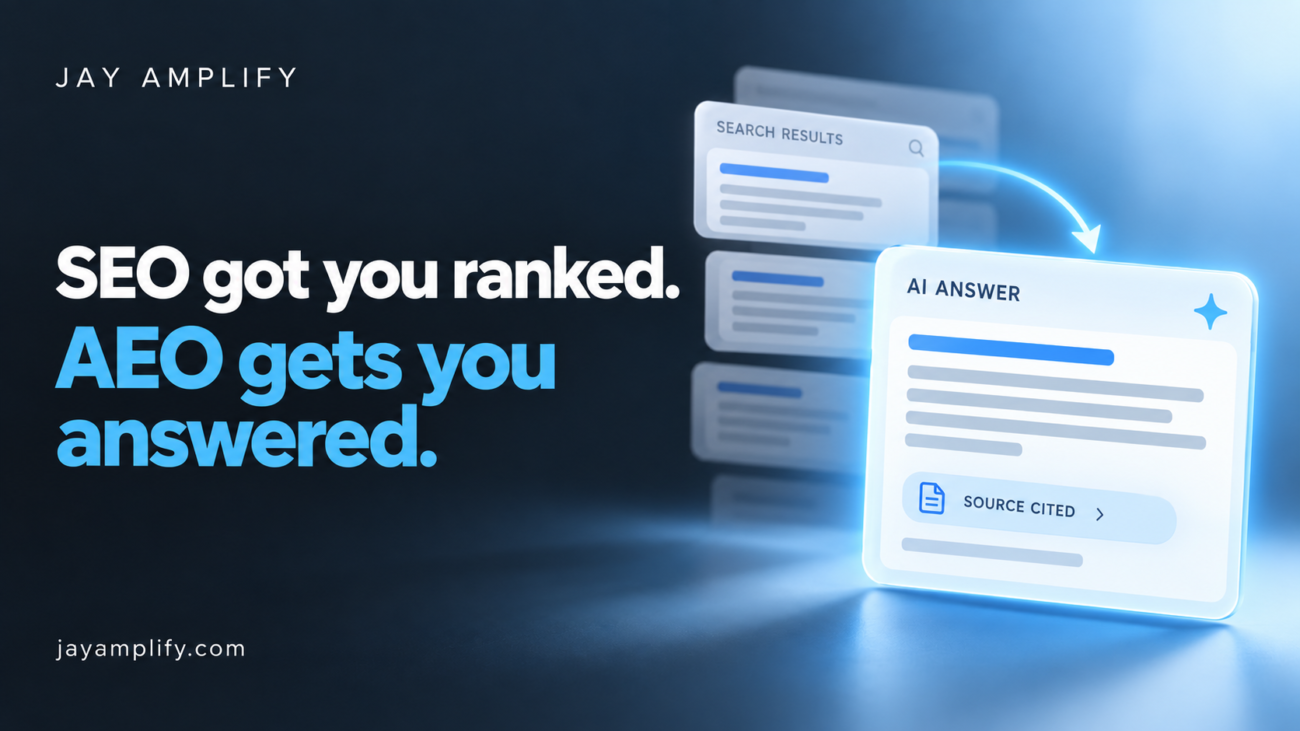
SEO vs AEO in one line

  • SEO: get found in a list of results.
  • AEO: get cited in the only result.

Same goal (be the source people find), different mechanics. Search engines reward keywords, backlinks and authority signals. Answer engines reward content that’s clear, structured, factual and easy for a model to lift and quote.

The upside is bigger. A top-three Google ranking still splits traffic with nine other sites. Being the source an AI cites is closer to a monopoly on that question.

“Can’t I just buy my way in?”

You can try. ChatGPT ads launched in early 2026 and self-serve access opened in May. Google is doing the same in AI Overviews. The money is flowing in.

The results aren’t flowing back. Here’s the problem in three parts.

1. Nobody knows what “good” looks like. OpenAI hasn’t published cross-advertiser benchmarks for click-through rate, conversion rate, cost per acquisition or return on ad spend. Every advertiser is guessing at what their numbers should be.

2. You can’t measure it properly. The platform is privacy-first by design, which makes user-level attribution weak from day one. Third-party measurement has been promised but no partners or timeline have been named. Dashboard conversions tell you what the platform tracked, not what you’d have got without the spend. The only way to prove it works is running holdout experiments, and most businesses aren’t set up for that.

3. The inventory is unstable. Ad frequency has swung from a quarter of replies, to almost zero, to over half within weeks. Pricing has compressed sharply since launch. Coverage is heavily US-weighted. Some categories get ads on nearly every relevant prompt; others get none. You’re buying into a market that hasn’t found its floor.

Paid AI placement will mature. Right now it’s a bet with no scoreboard.

Where the money actually is

Organic AI visibility. The answer the model gives before it appends a sponsored link.

That answer is built from content it trusts. Getting into it costs time, not media budget, and the return compounds. A page that’s cited today is still cited next month. An ad stops the moment you stop paying.

What AEO actually looks like

Most of it is good SEO done properly, plus a few things search never forced you to do:

  • Answer the question in the first sentence. Models lift direct answers. Don’t bury them under 400 words of preamble.
  • Structure for extraction. Clear headings, short paragraphs, FAQs, tables. Make your content easy to quote.
  • Be specific and factual. Numbers, names, dates, definitions. Vague content doesn’t get cited.
  • Use schema markup. FAQ, HowTo, Product, Organisation. It’s how machines confirm what your page is about.
  • Build entity authority. Consistent business details everywhere. Mentions on sites the models already trust. Reviews, directories, industry publications.
  • Cover the whole question, not just the keyword. Answer engines pull the most complete source, not the one with the best keyword density.
  • Keep it current. Models favour recently updated content for anything time-sensitive.

The honest bottom line

SEO isn’t dead. Google still sends more traffic than any AI tool. But the share of questions being answered without a click is growing every quarter, and paid placement in that space can’t yet prove its worth.

The businesses that win the next five years will be the ones the answer engines already trust. That’s earned, not bought.

Start earning it now.
Facebook page vs website

Facebook Page vs Website for a Small Business: Which Do You Need?

Facebook Page vs Website for a Small Business: Which One Do You Actually Need?

If you run a small business — plumbing, pest control, mowing, removals, a dental practice — you’ve probably asked this at some point: I’ve got a Facebook page. Do I really need a website too?

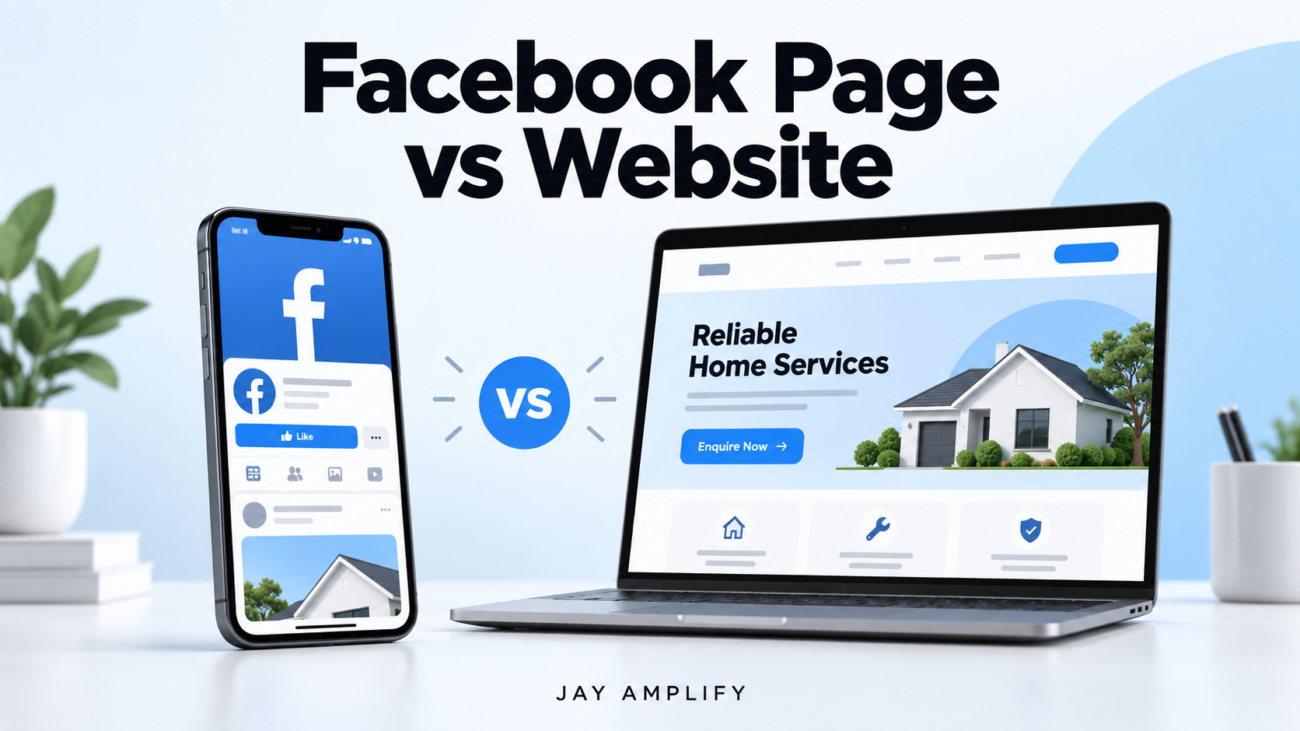
Short answer: yes. A Facebook page and a website do different jobs. Facebook keeps you in front of people who already know you. A website brings you the people who don’t.

Here’s the honest breakdown.

What a Facebook page does well

Facebook is free, fast, and your customers are already on it. It’s good at:

  • Staying in front of existing customers. Post a job you finished, a before-and-after, a public holiday closure.
  • Word of mouth. People tag you in local community groups. A lot of tradie work in Brisbane still comes from there.
  • Reviews and recommendations. Facebook reviews build trust quickly.
  • Messaging. Customers can DM you without picking up the phone.

Keep your Facebook page. It’s a useful channel. It’s just not the foundation.

Where a Facebook page falls short

The problem isn’t what Facebook does. It’s what it doesn’t do.

You don’t get found on Google. When someone types “emergency plumber Wynnum” into Google, Facebook pages rarely show up. Websites and Google Business Profiles do. If you’re Facebook-only, you’re invisible to the people searching for your service right now — and they’re the ones ready to book.

You don’t own it. Facebook can change the rules, restrict your reach, or lock your page over a copyright flag. Businesses lose years of posts and followers overnight. Your page is rented space.

Reach keeps dropping. Only a small slice of your followers see any given post unless you pay to boost it. Free reach on Facebook has been shrinking for a decade.

It looks like everyone else. A Facebook page can’t show that you’re a professional outfit. Your competitor with a clean website looks more established, even if you do better work.

No control over the customer journey. You can’t build a proper quote form, show your service area, list your pricing, or explain your process the way you want.

What a website does that Facebook can’t

A website is your own piece of the internet. It works for you 24/7, whether or not anyone is scrolling.

  • Google ranking. A properly built site with your services, suburbs and structured data (schema) can rank for searches like “pest control Redlands” or “removalist bayside Brisbane.” That’s high-intent traffic — people ready to book.
  • Credibility. A website with your ABN, licence number, photos and reviews tells a customer you’re legitimate before they call.
  • Your own domain and email. info@yourbusiness.com.au beats a Gmail address on a quote.
  • Ownership. Nobody can shut it down or change the algorithm on you.
  • Somewhere to send people. Every ad, flyer, van sticker and Facebook post can point to one place that’s built to convert.

Facebook page vs website: side by side

Facebook pageWebsite
CostFreeOne-off build fee + hosting
Shows up in Google searchRarelyYes
You own itNoYes
Professional appearanceLimitedFull control
Quote / contact formsBasicCustom
Reach without payingShrinkingUnlimited
Setup time10 minutesDays (or hours, if it’s done right)

“But my Facebook page is working fine”

That’s fair — and keep it going. Nobody’s saying delete Facebook.

The question is how much work you’re not getting. Every day, people in your area are Googling your service and calling someone else because that someone else has a website and you don’t. You never see those jobs, so it feels like nothing’s missing. It is.

How much does a small business website cost in Australia?

This is where a lot of tradies get put off. Agencies quote $3,000–$10,000 for a site a mowing business doesn’t need. Free builders like Wix look cheap until you add a domain, remove the ads and pay every month forever.

There’s a middle path. At Jay Amplify, a single-page, fully responsive website is $695 one-off, including your domain name and 12 months of hosting. No monthly fees, no lock-in, and it’s built to rank on Google from day one.

So which one do you need?

Both. The only question is how you use each.

Just starting out? Set up a Facebook page, a Google Business Profile and a website in the same week. The website is the one Google sends customers to, and at $695 it’s cheaper than a week of missed calls.

Already got work coming in? Get the website, point your Facebook page at it, and let Google bring you the customers who are searching right now.

Established and still Facebook-only? You’re leaving money on the table. This is the easiest fix in your business.

Frequently asked questions

Can a Facebook page replace a website? No. Facebook is good for community and updates, but it doesn’t rank on Google and you don’t own it. A website does both.

Do I need a website if I’m on hipages or Airtasker? Those platforms send you leads but charge for them and line you up next to competitors. A website brings customers directly to you, with no fee per lead.

Is a one-page website enough for a tradie? Usually, yes. Services, service area, photos, reviews, phone number and a contact form is all most customers need. You can add pages later.

How long does it take to get a website built? Big agencies take weeks. A focused one-page build can be done in a day.


Ready to get found on Google? See what a $695 website looks like — check out our example sites for plumbing, pest control and professional services, or get in touch for a quote.

Picture1

WHY YOUR SMALL BUSINESS NEEDS A WEBSITE

Build trust. Get found. Turn interest into enquiries.

When you are starting or growing a small business, it is easy to rely on social media, directories and word of mouth. Those channels can help, but they do not give customers a complete picture of your business.

A professional website becomes your digital home – a place where people can understand what you offer, see that your business is credible and contact you when they are ready.

Your website should make a potential customer feel confident before they ever call or email you.

Five Reasons a Website Matters

For a smaller business or startup, a simple and well-designed website can make an immediate difference.

01Be found when customers search When someone hears about your business, they will often search online before making contact. A website gives them a reliable place to confirm your services, location and contact details.
02Build trust before the first conversation A professional website helps a new business look established. Clear service information and consistent branding reassure customers that they are dealing with a credible provider.
03Own your online presence Social media is useful, but platforms control the layout, reach and rules. Your website is a space you control, designed around your business rather than a distracting feed.
04Make it easy to take the next step A strong website guides visitors towards an enquiry. It answers the basics, explains your value and keeps your phone number or contact form within easy reach.
05Support every other marketing channel Business cards, referrals, networking, social media and advertising all work better when they lead to a professional website that clearly explains what you do.
BE FOUND Show up when customers look onlineBUILD TRUST Look established and professionalGET ENQUIRIES Make the next step simple

You Do Not Need a Complicated Website

For most service-based businesses, the goal is not to build the biggest website. The goal is to build the right website – one that is clear, fast, mobile-friendly and easy to use.

A GOOD WEBSITE SHOULD ✓  Clearly explain your services ✓  Work properly on mobile devices ✓  Show where your business operatesA GOOD WEBSITE SHOULD ✓  Make contact simple ✓  Reflect your branding professionally ✓  Give customers a reason to choose you

A Website Works While You Are Busy

While you are serving customers, quoting jobs or running the day-to-day business, your website continues to introduce your services. People can visit after hours, compare their options and send an enquiry when it suits them.

Start With a Strong Foundation

A simple professional website gives your business room to grow. Over time, it can support search visibility, advertising, new service pages and stronger marketing campaigns.