
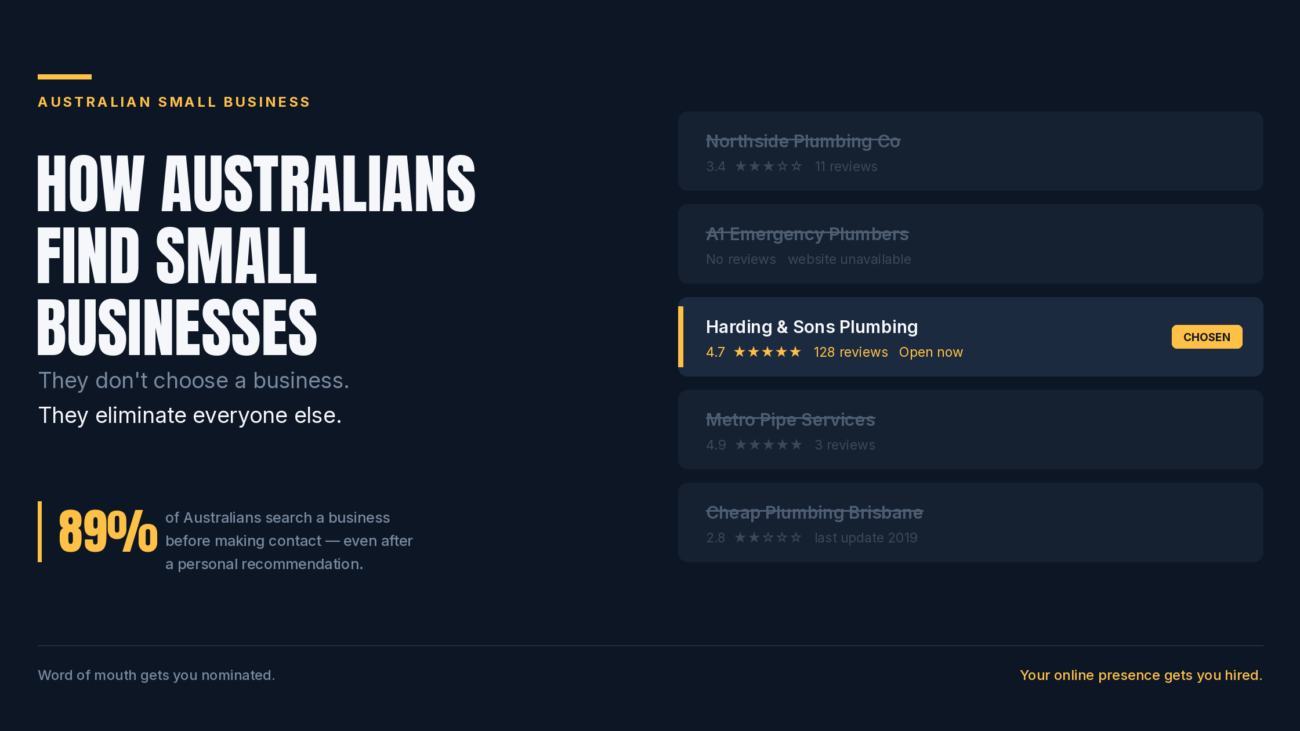
Australians don’t pick a small business. They eliminate the ones that don’t feel safe — and most of that happens before anyone picks up the phone.
Understanding that funnel is the difference between waiting for the phone to ring and building something that rings it for you. Here’s how the decision actually gets made, and which signals carry the most weight.
The process, step by step
1. Someone plants the seed
A mate, a neighbour, a local Facebook group. Referrals still start the majority of jobs in Australia — and they always will.
2. They Google you anyway
Around 89% of Australians search a business before making contact — even after receiving a personal recommendation. Google handles roughly 88% of all search traffic in Australia, so this step is effectively universal.
3. They read reviews before your website
94% of Australian consumers read reviews before buying. Google Reviews dominates at around 89% usage, with Facebook Reviews close behind at 73%. Your star rating is often the first thing anyone sees about you.
4. They check that you’re real
A working website. Recent photos. A licence number. Evidence you were trading this year. Trades and home services are the latest category being reshaped by this — homeowners now expect verified profiles and transparent credentials.
5. They shortlist two or three and call the safest option
Not the cheapest. The one that carries the least risk of a job gone wrong.
What Australians trust most
| Signal | Why it carries weight | |
|---|---|---|
| 1 | A personal referral | Converts higher than anything else — but you can’t scale it or switch it on when work dries up. |
| 2 | Recent, plentiful reviews | 78% of Australians trust online reviews as much as a personal recommendation. |
| 3 | How you handle criticism | Customers pay more attention to your reply than to the complaint. A 4–4.5 star average reads as more credible than a flawless five. |
| 4 | A website that looks current | Outdated design signals an outdated business. Fair or not, it’s an instant filter. |
| 5 | Proof — licences, photos, real names | Every piece of verifiable detail removes a reason to choose someone else. |
The trap most small businesses fall into
Australian tradies are the clearest example. Roughly 70% rely primarily on word of mouth. About 76% have a website — but most aren’t using it to attract anyone, and only 17% do any search optimisation at all.
So the referral arrives, the customer Googles the name, and finds nothing convincing. That job goes to the competitor three spots below in the search results.
Discovery is fragmenting. Consumers now check an average of six review platforms before choosing, and AI assistants have surged from 6% to 45% usage for local business recommendations in a single year — while Google’s share of local discovery fell from 83% to 71%.
An AI assistant doesn’t visit your shop. It reads your reviews, your listings and your website, then recommends someone.
Those last figures come from US survey data, but the behaviour is landing here fast.
What to do about it
- Claim and finish your Google Business Profile. Free, and the single highest-return hour you’ll spend.
- Build a system for asking for reviews. Every customer, every time, with a direct link.
- Reply to every review — especially the bad ones. That reply is being read by your next customer.
- Make your website answer the obvious questions: what you do, where you work, what it costs, who you’ve done it for.
- Keep it current. New photos and a recent post do more for trust than a redesign.
Word of mouth gets you nominated. Your online presence gets you hired.